2D MMORPG engines: what developers and press have confirmed
Few publishers say what engine runs a 2D MMORPG. This guide lists the 2D MMORPG engines and technologies that a published report confirms, from Dofus to Albion Online and RuneScape, and the gaps.
Checked .

What this guide covers
Engine talk is rare in the games this site follows. Press releases about Korean free-to-play titles of 2010 to 2013 describe features, launch dates and servers, and almost never the technology underneath. So this guide names a 2D MMORPG engine only when a developer interview, a studio post or a press report says so.
Most of the confirmed material comes from Ankama of France, which talked to the press about its tools. Three more sources add a modern Unity case, Jagex's client posts and Adobe's end-of-life notice for Flash.
From Java and Flash to Unity
Six stops on the sourced chain, oldest first.
Ankama: Java
Dofus-Arena is coded in Java with a graphic engine built from scratch, and Wakfu is encoded in Java.
Source: Gamasutra, 17 April 2008; Ten Ton Hammer, 4 June 2008The original Dofus: Flash
Ankama's Chafer calls Flash a platform not meant for game development that struggles with many animations at once.
Source: Gamasutra, 1 October 2009Adobe ends Flash Player support
Flash content is blocked from running in Flash Player from 12 January 2021.
Source: Adobe end-of-life pageDofus moves to Unity
MassivelyOP reports the move from Flash to Unity. How Ankama handled Flash in between is unclear.
Source: MassivelyOP headline, 28 October 2024Jagex retires its Legacy Java Client
The C++ client becomes the Official Client. RuneLite and HDOS, both Java-based, are not affected.
Source: Jagex post, 22 November 2024Albion Online: a Unity case study
Unity handles input and rendering while the core simulation layer is independent of Unity.
Source: Unity case study by Fergus Baird, 12 May 2026
What the sources confirm
Technology named by a source
Dofus (original)
- Technology
- Flash
- Source and date
- RPGFan interview with Ankama (undated); Gamasutra, 1 October 2009
Dofus-Arena
- Technology
- Java, graphics engine built from scratch
- Source and date
- Gamasutra Q&A, 17 April 2008
Wakfu
- Technology
- Java
- Source and date
- Ten Ton Hammer interview, 4 June 2008
Dofus (2024)
- Technology
- Moved from Flash to Unity
- Source and date
- MassivelyOP headline, 28 October 2024
Albion Online
- Technology
- Unity for input and rendering; separate simulation layer
- Source and date
- Unity case study by Fergus Baird, 12 May 2026
Old School RuneScape
- Technology
- Legacy Java Client retired; C++ Official Client; RuneLite and HDOS (Java) unaffected
- Source and date
- Jagex post, 22 November 2024
Flash (platform)
- Technology
- Support ended 31 December 2020; content blocked from 12 January 2021
- Source and date
- Adobe end-of-life page
Only technologies named in the cited source are listed. Status is as of 30 October 2026.
Flash: the original Dofus
RPGFan's interview with Ankama calls the first Dofus a turn-based strategy MMORPG based in Flash. Gamasutra's interview of 1 October 2009 goes further. Ankama's Chafer called Flash a platform not meant to be used for game development, and said that Flash had trouble displaying too many animations at once.
The same interview says the game began as a turn-based, PvP-only fighting game. That is a design origin, and the article does not say it shaped the engine choice.
Moving off Flash
MassivelyOP's headline of 28 October 2024 says Ankama was moving its classic MMO Dofus from Flash to the Unity engine on 3 December. Adobe ended Flash support in 2020, but this guide cites nothing that links that date to Ankama's decision, so it draws no connection.
Java: Dofus-Arena and Wakfu
Gamasutra's Q&A of 17 April 2008 says Dofus-Arena is coded in Java and that its graphic engine was developed from scratch. The same piece does not name Wakfu's language.
Ten Ton Hammer's interview of 4 June 2008 does. Ankama's team said Wakfu would be encoded in Java, and that Java let them build a world players could walk around in, described as a multidirectional scrolling isometric 3D universe. The phrase is the developers' own, and this guide does not interpret it further.
Two modern games and their clients
The two cleanest current examples, each from the developer's or publisher's own account.
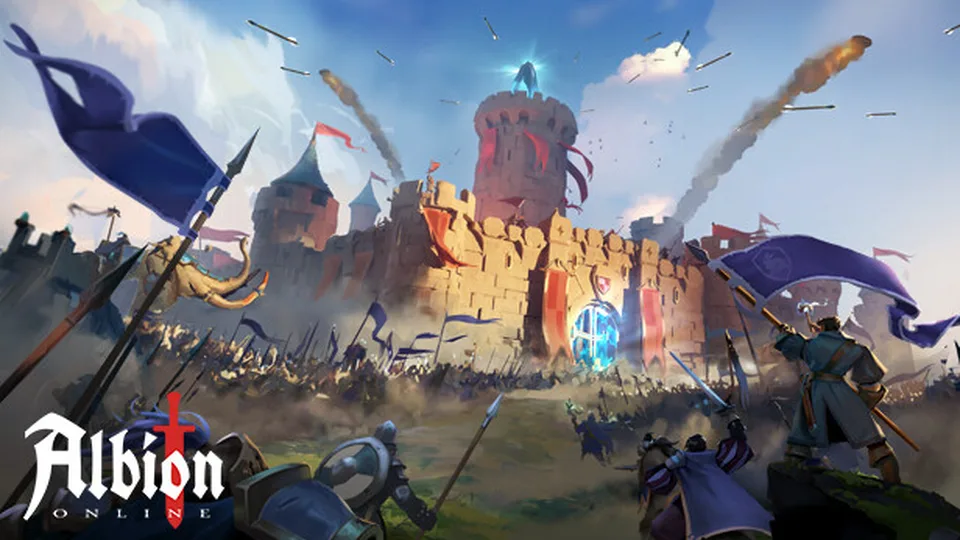
Image: Sandbox Interactive GmbH, from the Albion Online Steam store page. Shown to identify the game; the image belongs to its owners. Albion Online
Albion Online is the clearest modern case. A Unity case study dated 12 May 2026, written by Fergus Baird of Unity Technologies, says the team runs the game from a single Unity project and that players use one login across platforms. Principal game engineer David Eibensteiner is quoted saying the core simulation layer is completely independent of Unity, with Unity used for input and rendering. The same article describes how the simulation predicts an action on the client while sending updates to the authoritative server. It also says every developer can run the full server-client stack locally. Those are the only places the article touches server authority, and it does not explain hosting.
- Technology
- Unity for input and rendering
- Source
- Unity case study, 12 May 2026
Image: Jagex Ltd, from the Old School RuneScape Steam store page. Shown to identify the game; the image belongs to its owners. Old School RuneScape
Jagex published a post on 22 November 2024 about retiring its Legacy Java Client. The post says the C++ client, released on Steam and later through the Jagex Launcher, became the Official Client, while the Java client became the Legacy Java Client. Jagex said that from early 2025 players would no longer be able to use the Legacy Java Client. The post also states that other Java-based clients such as RuneLite or HDOS would not be affected. That is a statement about third-party clients, and it does not say what the game server runs on.
- Technology
- C++ Official Client
- Source
- Jagex post, 22 November 2024
Terms the sources define
Only three common concepts have a definition in a source this guide read. Sprites and tile maps are not among them, because none of the sources describes them.
- Authoritative server: in the Unity case study, the server that receives the client's predicted actions as updates. The article does not define the term beyond that sentence.
- Simulation layer: in the same study, game logic that Eibensteiner calls completely independent of Unity, so rendering and input sit in a separate layer.
- Multidirectional scrolling isometric 3D universe: Ankama's own words to Ten Ton Hammer on 4 June 2008 for what Java let it build in Wakfu.
Flash and its end of life
Adobe's end-of-life page says it stopped supporting Flash Player on 31 December 2020, after first announcing the date in July 2017. It also says Adobe blocked Flash content from running in Flash Player from 12 January 2021 and stopped releasing updates and security patches.
For Dofus, the sourced chain is short. Ankama's Gamasutra interview of 1 October 2009 places the original game in Flash, and MassivelyOP reported on 28 October 2024 that Dofus was moving to Unity. What Ankama did about Flash between those dates is not documented.
Dofus Touch
PocketGamer reported on 3 April 2024 that Dofus Touch, first released in 2016, was relaunching on Android and iOS with a new English server, free to play with optional purchases. The article does not name an engine, so this guide does not either.
Engines left out
We searched for official statements on MapleStory and Tibia. No Nexon statement naming MapleStory's engine turned up, and the one Tibia item that named a client technology was a forum thread without CipSoft as the author. Both are left out.
Open questions
The engine or toolkit behind Atlantica Online, WonderKing, Karos Online, Rosh Online, DarkEden, WindSlayer 2 and SevenCore is not named in any material found. Their pages on this site cover what is recorded about them, and the technology is not part of it.
It is also unclear whether any Korean 2D MMORPG of the period used a commercial engine, or how Ankama's Java client rendered its art. Statements about Unity, Godot or Cocos in any of these games would need a postmortem or a developer talk, and none was found. This page will take them when one appears.
Questions about 2D MMORPG engines
What engine did Dofus use?
The original Dofus was built in Flash, according to Ankama's interviews with RPGFan and Gamasutra. MassivelyOP reported on 28 October 2024 that it was moving to Unity.
What language is Wakfu written in?
Ankama's team told Ten Ton Hammer on 4 June 2008 that Wakfu would be encoded in Java.
Which engine did WonderKing or Atlantica Online use?
Neither game's engine is documented.
Which 2D online game names Unity as its engine?
Albion Online does, in a Unity case study of 12 May 2026 that says Unity handles input and rendering. Ankama also moved Dofus from Flash to Unity, per MassivelyOP on 28 October 2024.
When did Flash stop working?
Adobe ended support for Flash Player on 31 December 2020 and blocked Flash content from running from 12 January 2021.
Does Old School RuneScape still have a Java client?
Jagex said on 22 November 2024 that it would retire the Legacy Java Client, and that RuneLite and HDOS would not be affected.